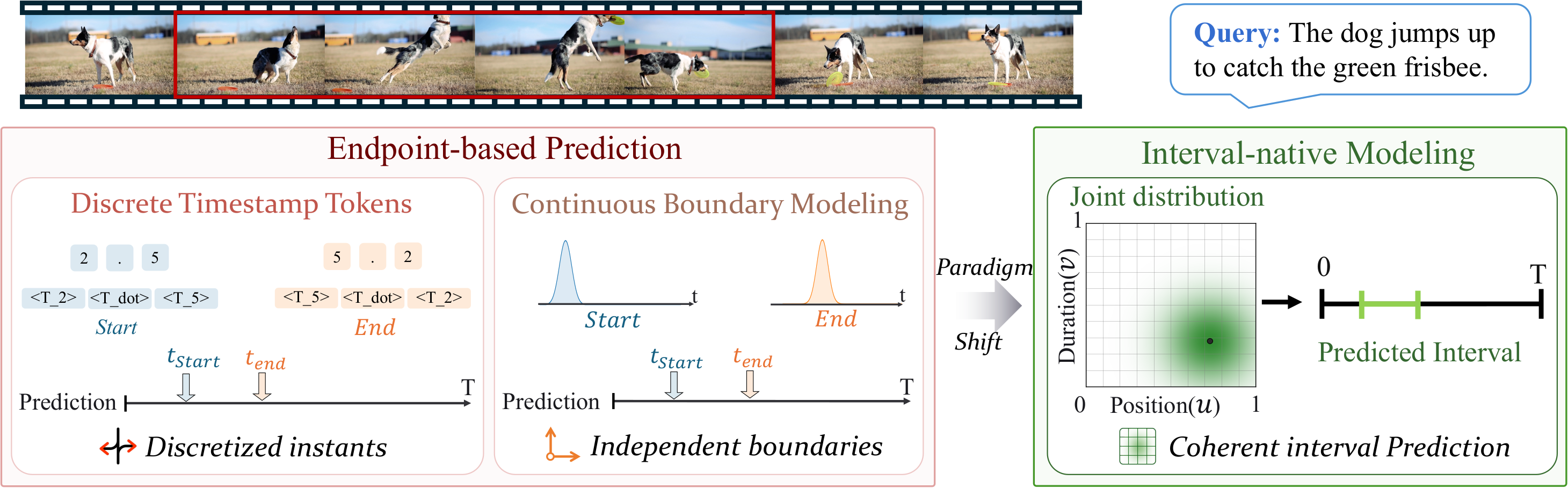
Endpoint prediction
Two decisions fragment one moment.
startend
The event interval is assembled afterward; duration and interval-level similarity remain implicit.
Overview · From Endpoints to Intervals
Endpoint prediction
The event interval is assembled afterward; duration and interval-level similarity remain implicit.
Interval-native prediction
Every canonical coordinate maps to a valid interval and directly supports interval-level prediction.
§2 · TimePLE
TimePLE preserves the autoregressive language interface while giving temporal grounding a native interval geometry.
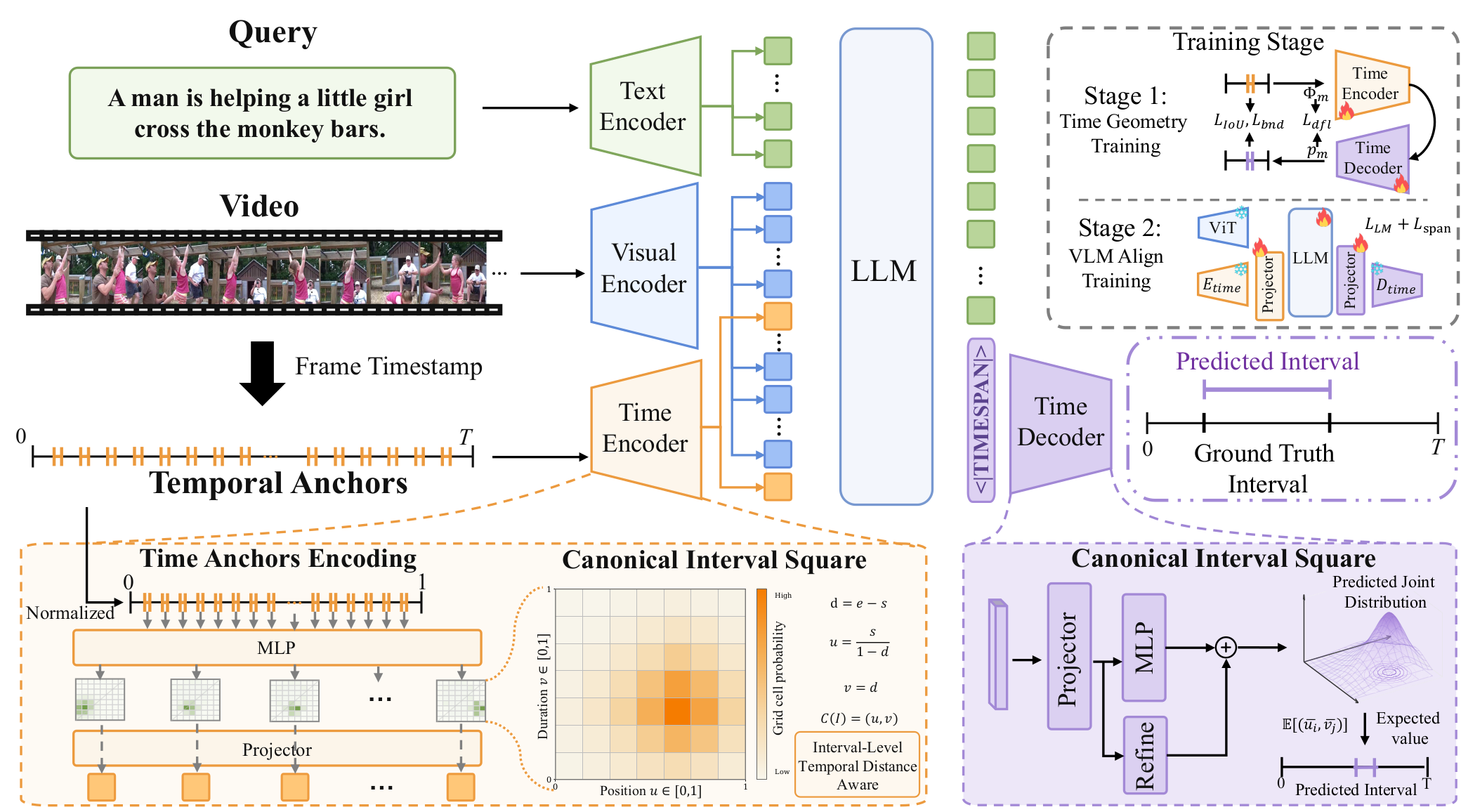
Why. Start–end coordinates occupy a constrained triangle and do not expose duration directly.
Advantage. Its inverse maps every square coordinate to a valid interval.
Why. A complete moment should be supported by one coherent latent prediction.
Advantage. Joint decoding retains uncertainty before producing continuous boundaries.
Why. Short events suffer larger IoU drops from the same coordinate error.
Advantage. A bounded residual improves precision beyond grid expectation.
§3 · Experimental Evidence
Across four VTG benchmarks, TimePLE achieves the best average mIoU among the compared temporal-output paradigms, with its clearest advantages on short and medium events.
§3.1 Main Results
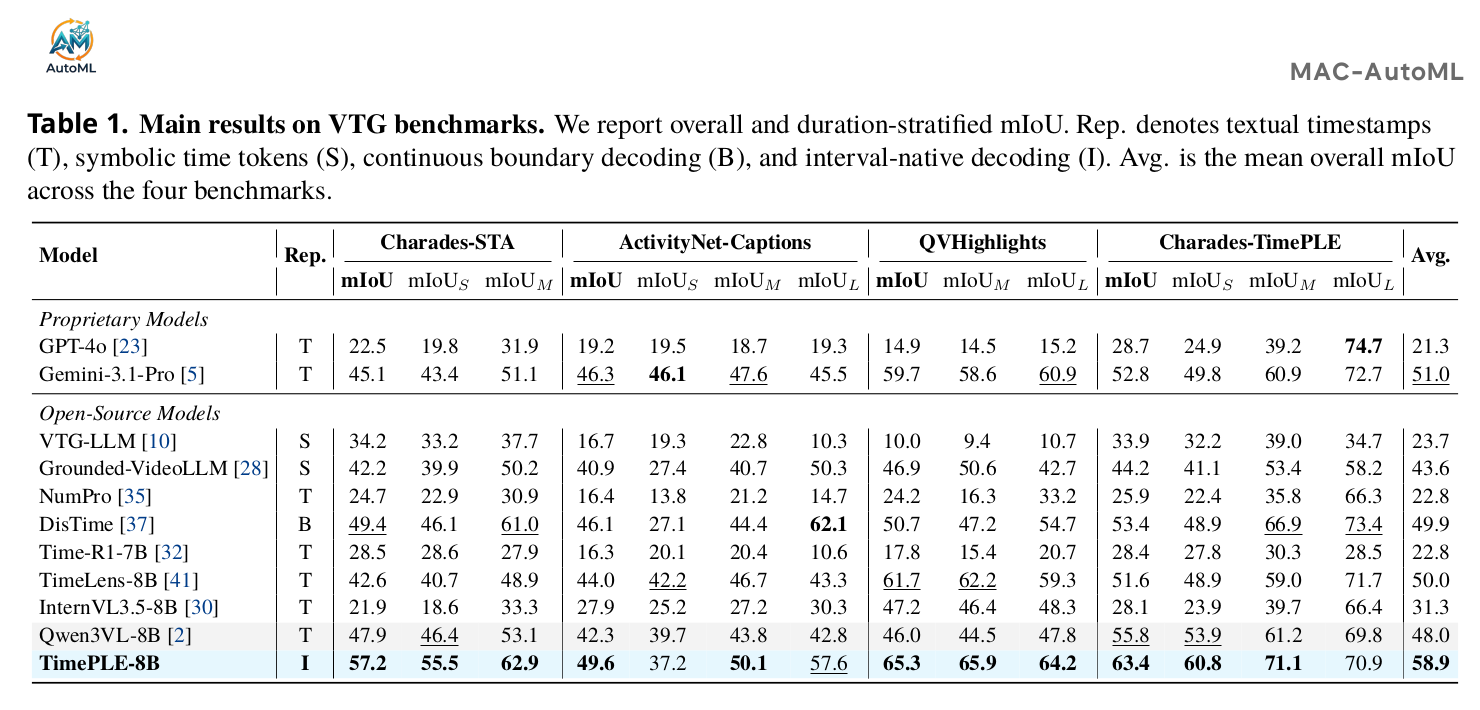
TimePLE-8B achieves 57.2 on Charades-STA, 49.6 on ActivityNet-Captions, 65.3 on QVHighlights, and 63.4 on Charades-TimePLE. Click the table to inspect the full-resolution results.
§3.2 Duration-Stratified Performance
Small temporal errors cause a larger loss of interval overlap for short and medium events. TimePLE improves these duration regimes while remaining competitive on long moments.
§4 · Representation-Level Analysis
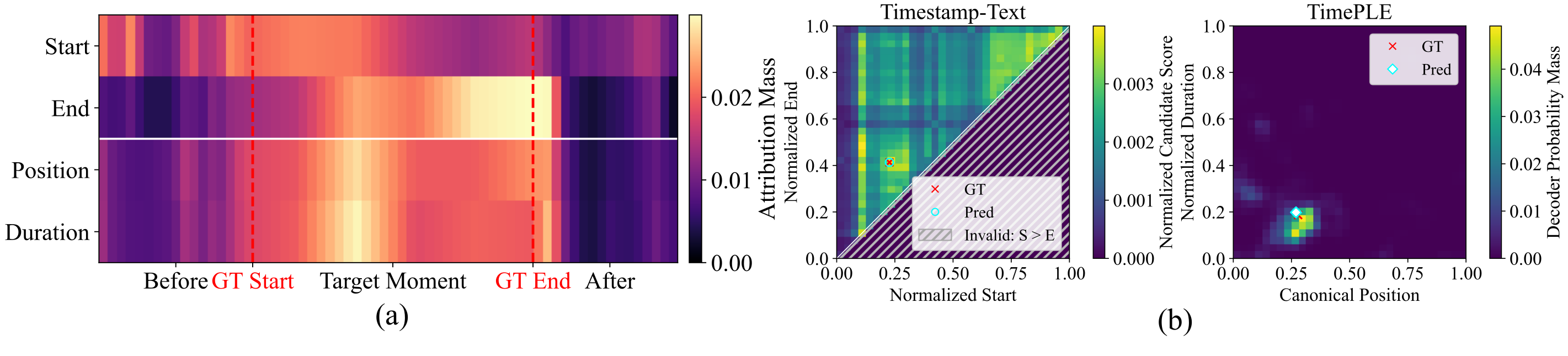
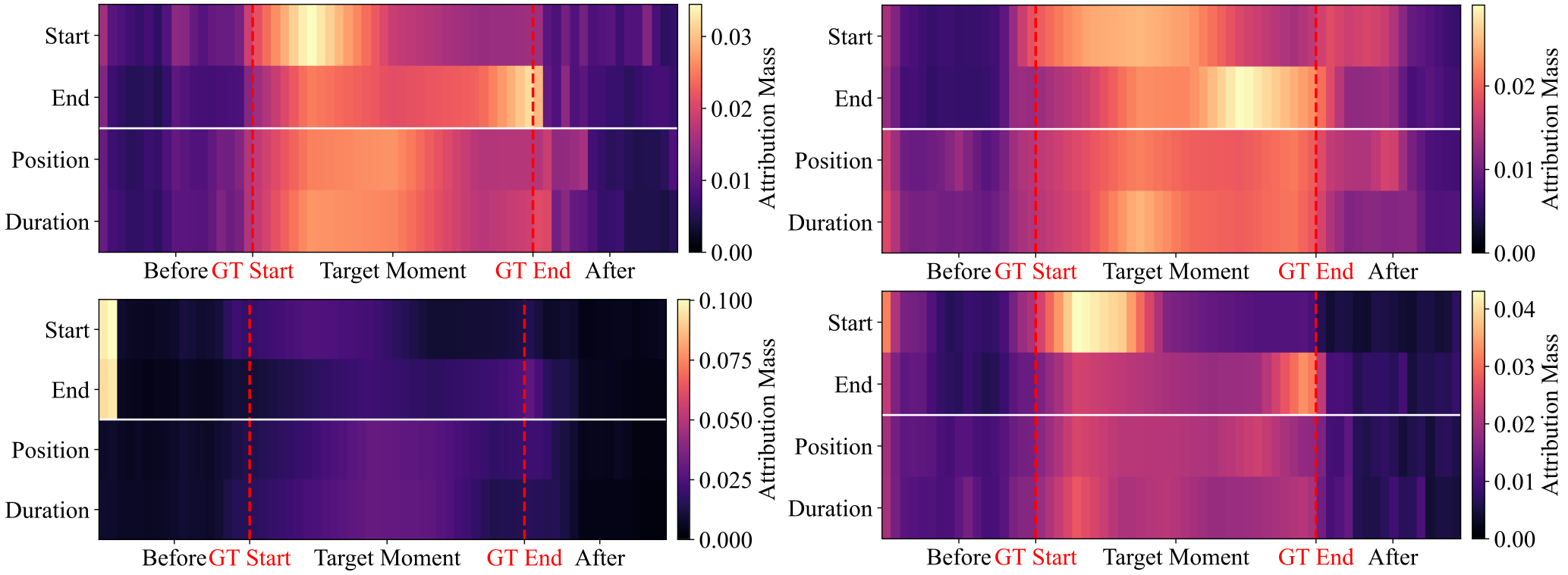
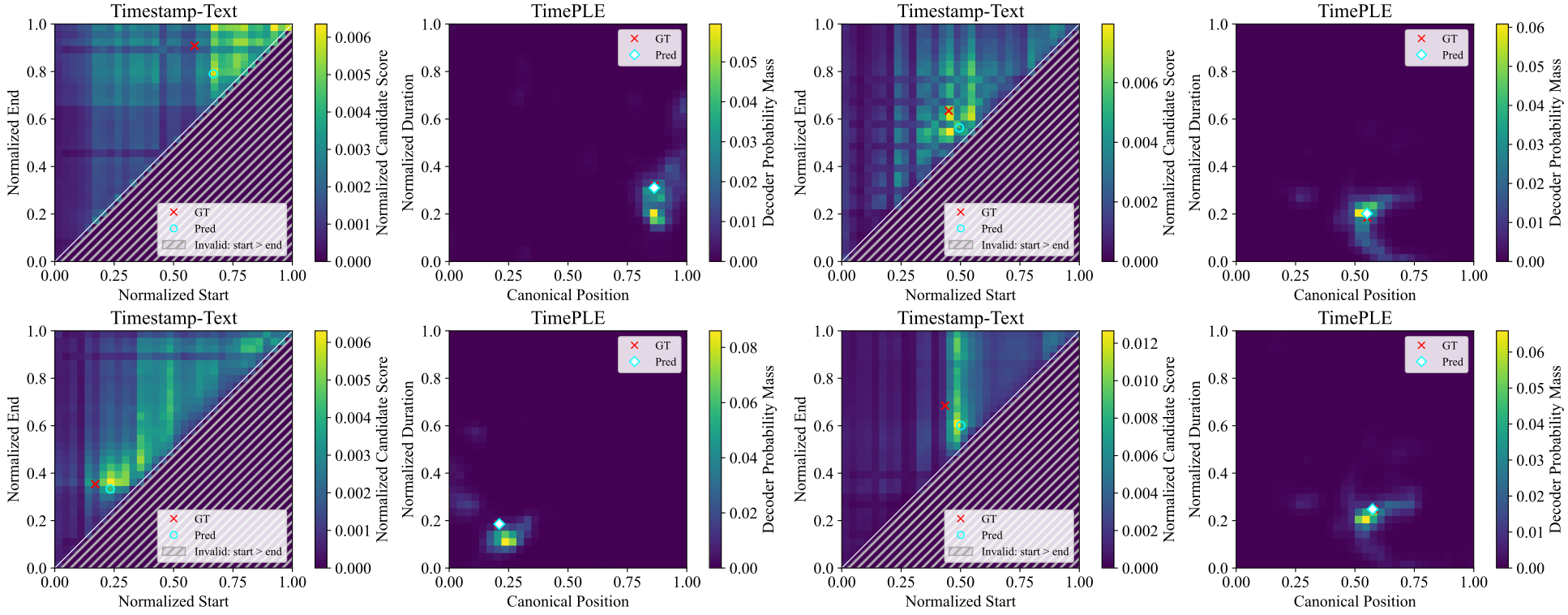
We examine whether changing the prediction object from two endpoints to one complete interval also changes the model's underlying temporal representation.
Additional Qualitative Cases
Data & Benchmark Quality
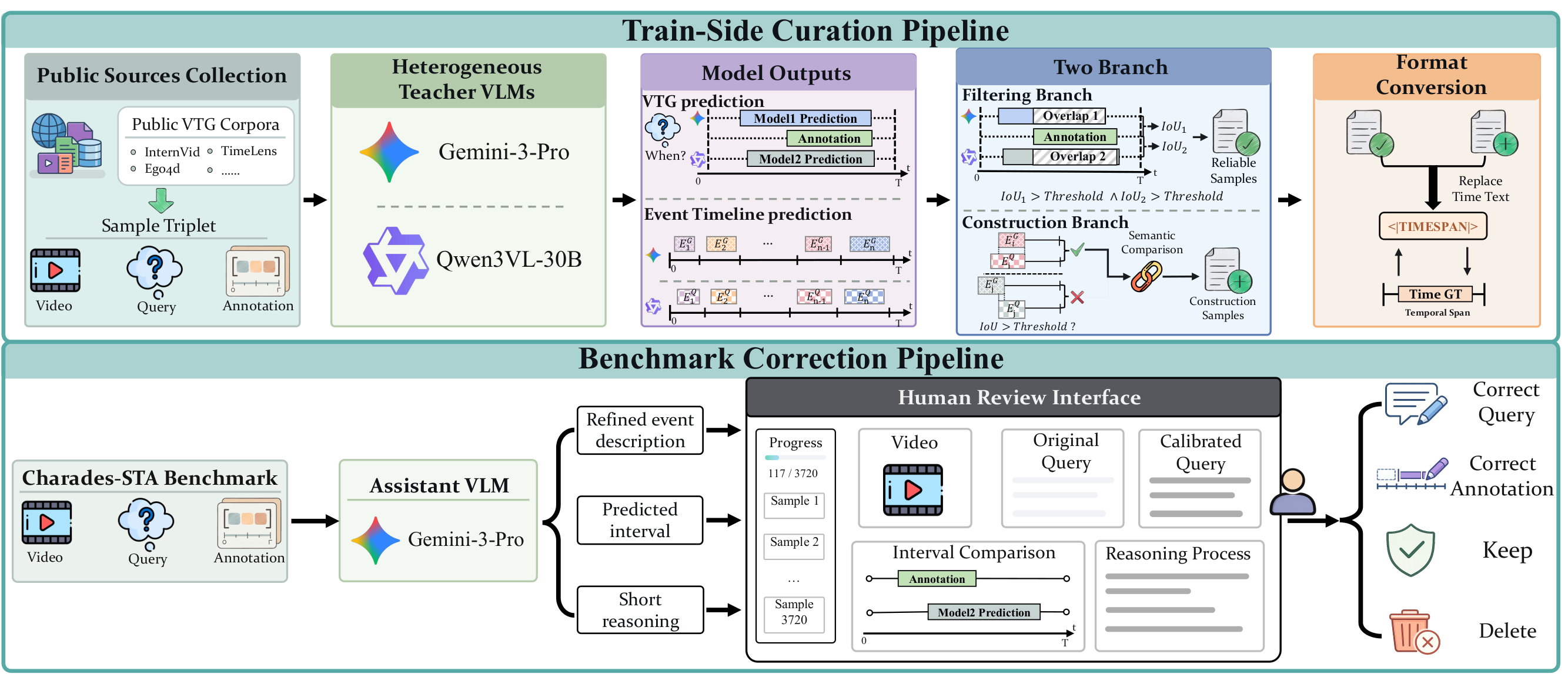
A multi-model curation and human-verification pipeline constructs grounded training data and corrects noisy benchmark annotations.
Full Results · Backbone Scaling
For every backbone, TimePLE and Timestamp-SFT use the same training data and video input configuration. The temporal prediction interface is the only change.
| Backbone | Method | C-STA | A-Net | QVH | C-TimePLE | Avg. |
|---|---|---|---|---|---|---|
| LLaVA-OV-0.5B | Timestamp-SFT | 23.8 | 10.8 | 6.5 | 24.7 | 16.5 |
| TimePLE | 40.2 +16.4 | 33.2 +22.4 | 32.3 +25.8 | 42.3 +17.6 | 37.0 +20.6 | |
| Qwen2.5-VL-3B | Timestamp-SFT | 51.2 | 41.6 | 59.3 | 57.8 | 52.5 |
| TimePLE | 52.3 +1.1 | 43.3 +1.7 | 59.4 +0.1 | 58.5 +0.7 | 53.4 +0.9 | |
| Qwen3-VL-8B | Timestamp-SFT | 51.6 | 47.3 | 63.6 | 56.7 | 54.8 |
| TimePLE | 57.2 +5.6 | 49.6 +2.3 | 65.3 +1.7 | 63.4 +6.7 | 58.9 +4.1 |
All values are mIoU. Green rows use TimePLE's interval-native representation; +x.x reports the absolute gain over the matched Timestamp-SFT baseline. C-STA, A-Net, QVH, and C-TimePLE denote Charades-STA, ActivityNet-Captions, QVHighlights, and Charades-TimePLE.
Resources
@article{zeng2026timeple,
  title   = {TimePLE: Rethinking Temporal Representation for Video Temporal Grounding},
  author  = {Zeng, Yuhui and Mao, Xinyu and Liu, Xiaokun and Tao, Xin and Wan, Pengfei and Huang, Jinfa and Ji, Jiayi and Zheng, Xiawu},
  journal = {arXiv preprint},
  year    = {2026}
}
Provisional citation—update the venue and arXiv identifier when public.